
What another season of waiting actually costs you
If that garage door has been hanging on since the 90s, here's the honest math: a snapped torsion spring with no safety cable can whip loose with enough force to dent a car hood or break a bone. A door panel that's already bowing from wind pressure during afternoon storms won't get stronger on its own — it gets weaker every time it flexes. And an opener with no auto-reverse sensors is a real risk if a kid, pet, or bike is in the path when the door comes down. None of that gets better by waiting for next season. It gets more expensive, or more dangerous, or both.
So let's settle this the practical way: some parts of an old door are genuinely unsafe and worth fixing now. Others are just old and ugly, and that's fine.
What needs retrofitting, not debating
Auto-reverse sensors
Openers made before the early 1990s often shipped without photo-eye sensors — the little eyes near the floor that stop the door if something breaks the beam. If your opener predates that standard, this isn't a maybe. It's a straightforward safety retrofit, and it's one of the cheaper fixes on this list.
Springs without a containment cable
Torsion springs wear out, that's normal. What's not fine is a spring with no safety cable running through it. When it breaks — and old springs do break, especially with the heat cycling and humidity swings common down here — the cable keeps it from becoming a projectile. If you've never had this checked, it's worth a look before the spring decides the timing for you.
Bracing for wind load
Older doors, especially ones installed before wind-load bracing became standard practice in hurricane-prone areas, often weren't built or reinforced to handle sustained gusts the way current doors are. You don't necessarily need a full replacement to address this — a reinforcement kit (horizontal struts bolted across the panels) can be added to many existing doors. If the door is already dented, warped, or the track is pulling away from the frame, bracing a weak structure is a band-aid, and replacement is the more honest answer.
Rusted tracks, cables, and rollers
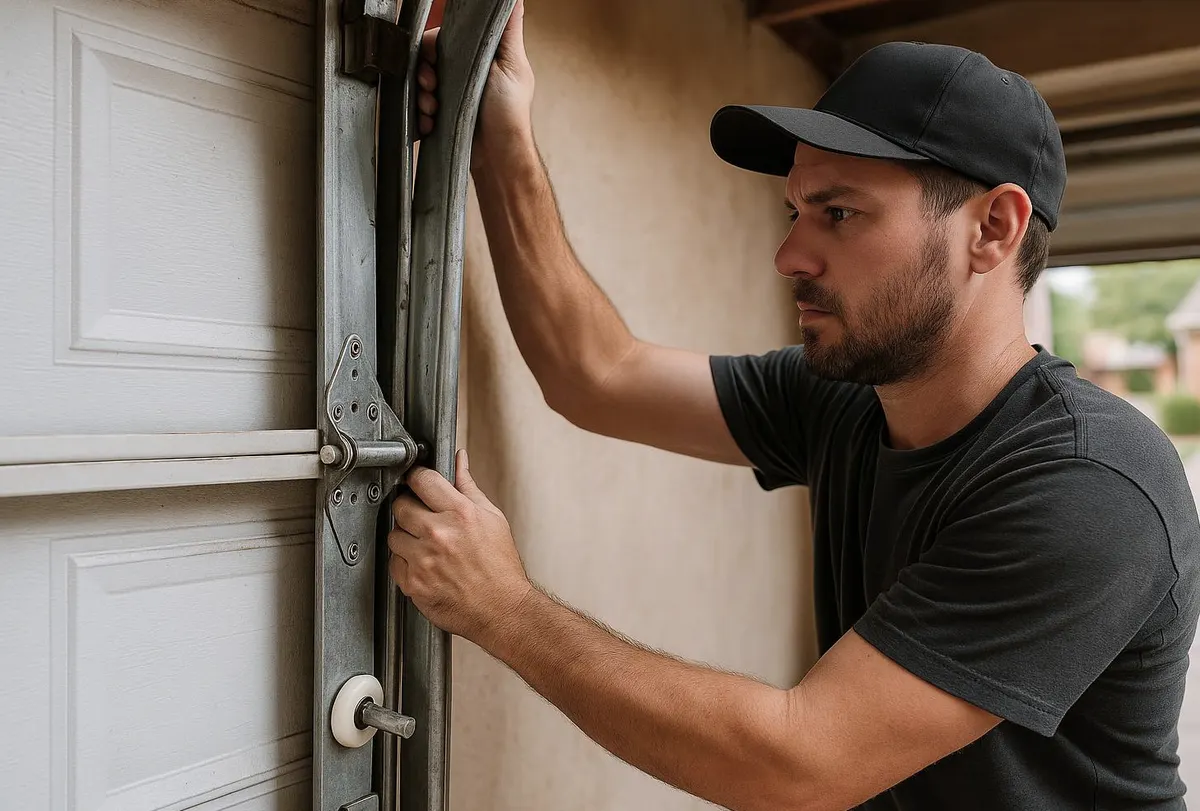
Salt air works on steel whether or not you can see it happening. Surface rust on hinges is cosmetic. Rust that's pitted the track, frayed a cable, or seized a roller is a mechanical failure waiting for a trigger — usually a hot, humid afternoon when the metal expands and something that was barely holding on finally lets go. Cable and roller replacement is routine work and far cheaper than what happens if a cable snaps while the door's halfway up.
Swollen or warped wood doors
If the original door is wood and it's been swelling and sticking every rainy season, that's moisture getting into the panel, not just a sealing issue. A door that drags on the track puts strain on the opener and springs that they weren't built for. At some point patching the wood is just delaying a replacement decision.
What's fine to leave alone
- Cosmetic rust or faded paint on hardware that isn't structural — sand and repaint it if it bothers you, but it's not a safety issue.
- A manual door with no opener, as long as the springs, cables, and track are sound. Plenty of older homes run manual doors safely for decades. Adding an opener is a convenience upgrade, not a necessity.
- An older but solid wood door that opens and closes smoothly and isn't warping. If it's not swelling, sticking, or sagging, there's no reason to replace something that's still doing its job.
- Minor dents in steel panels that don't affect the seal or the track alignment. Ugly isn't the same as unsafe.
The honest trade-off
Retrofitting individual parts — sensors, cables, bracing kits — makes sense when the door's structure and track are still solid. It's the cheaper path and it directly fixes the safety gaps. But if you're looking at rust throughout the track, a warped panel, and an opener from three decades ago all at once, you're not really retrofitting anymore — you're patching a door that's telling you it's done. At that point, a full replacement with a door built for current wind-load standards is usually the better long-term move, especially heading into another hurricane season.
When to call us
If you're not sure which category your door falls into, that's exactly what a tune-up visit is for. Key West Garage Door Service can run a full inspection — springs, cables, track alignment, opener sensors — and tell you plainly what's a safety fix and what can wait. If the spring's already showing wear or missing a containment cable, our Garage Door Spring Repair handles that directly. And if the inspection turns up enough wear across the board that patching doesn't make sense anymore, we'll walk you through Garage Door Installation & Replacement options built for Lower Keys wind and salt air, no pressure either way.
Settle the argument with a real answer, not a guess. Call Key West Garage Door Service for a straight assessment of your door, anywhere from Key West to Big Pine Key.